About This Book
도서 소개
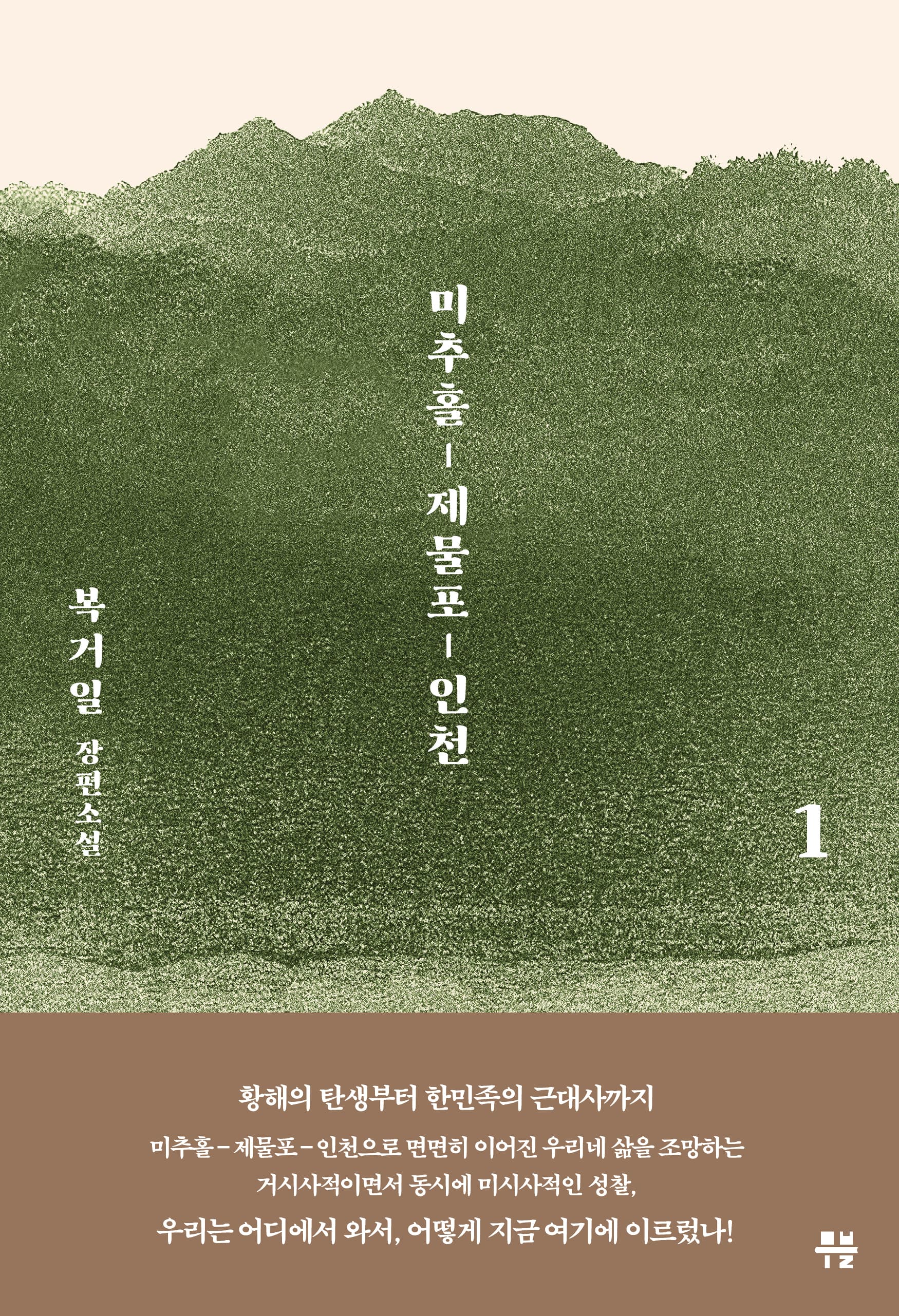
Where did we come from, and how did we get here? From the birth of the Yellow Sea to the modern history of the Korean Peninsula, this thought-provoking novel offers both a macro and micro reflection on our lives as it recounts the history and legacy of Michuhol, Jemulpo, and Incheon.
This rare novel presents a micro reflection of people surviving through the vast currents of history, and it also depicts the macro historical impact revealed by those individual lives. In an epic narrative, Bok Geo-il’s Michuhol-Jemulpo-Incheon chronologically portrays the history of Korea centered on the present-day Incheon area, starting with major historical events, such as the birth of the Yellow Sea and the first settlement of people on the Korean Peninsula. True to the title of the book, the novel intricately depicts the joys and sorrows of people’s lives as they intertwine with the history of Michuhol-Jemulpo-Incheon, a pivotal backdrop for the turning points in Korean history. Offering readers profound insight and deeply moving resonance, the epic narrative, which casts history itself as the main theme, merges history with detailed depictions of the people who lived it, and they are presented through the moving words of the writer whose craft reached its fullest expression in his later years.
Twenty-seven million years ago, the Yellow Sea first began to take shape. It was not until 25,000 years ago that the ancestors of people arrived on the Korean Peninsula to make it their home, and slowly stepped into the light of recorded history. Thus began the history of the Korean Peninsula—a grand panorama of twists and turns, turbulence, sorrow, and joy that has unfolded across the ages to reach the present day.
The fate of Prince Biryu, who was once the crown prince of Goguryeo before being displaced by Yuri from Northern Buyeo and later forced to yield his place again to his younger brother Onjo, is ultimately intertwined with that of Michuhol, where he finally founds his own kingdom. This is how Michuhol left a distinct mark on our history as a vital backdrop to a much larger historical current. The tragic legend of Prince Biryu and his mother Queen Soseono is refined and brought more to life by the writer, who combines it with historical facts and, in doing so, expands the historical dimensions of Michuhol-Jemulpo-Incheon.
The history of the Korean Peninsula, despite countless twists and turns, flows on like a vast, singular living entity, repeating cycles of joy and sorrow, triumph and despair. Michuhol-Jemulpo-Incheon brings out this history as the main character, a history that is rocky, fierce, and profoundly human.
By starting with the legend of Prince Biryu, the novel directs readers’ attention to a micro history of Michuhol-Jemulpo-Incheon. Later, to portray the grueling struggle and unwavering human resilience of a people who weather the storms of history with steadfast determination and carve out a life against all odds, the novel introduces Manseok, a naval soldier who dies while defending Jemulpo from foreign invaders, and his wife Wollye, who provides for her family after the death of her husband by running a tteok store. The undefeatability of the human spirit in the midst of the relentless march of history will resonate long after readers finish the novel.
The family saga of Manseok and Wollye set against the backdrop of Jemulpo and Incheon! The heart-wrenchingly beautiful story of people who are caught in the torrent of history!
History moves from the Three Kingdoms, to Unified Silla, to the rise and fall of Goryeo and Joseon. After the brutally oppressive era of Japanese colonization, Korea becomes the modern nation that rises from the ruins of war to stand tall as a global economic powerhouse. In the midst the turbulent times of history, the descendants of Manseok and Wollye become separated and later reunite as they carry on their lives in Incheon, accepting the cruel twists that fate deals them. The family lives through the opening of the ports, the Japanese occupation, the chaos of liberation, and the Korean War, and this family’s saga of witnessing firsthand the rise of a developing nation compels us to re-examine the very roots of who we are today.
From the birth of the Yellow Sea to the modern era that laid the foundation of South Korea, the chronicle of nonstop turns and dramatic events in the peninsula’s history naturally makes us wonder where we’ve come from and how we got here.
As you become immersed in the story, you will be humbled by how small we are in the face of history. Yet, at the same time, you feel a profound, newfound reverence for the greatness of humanity, which has sometimes endured the tides of fate, sometimes defied them with iron will, and sometimes rewritten destiny through sheer, indomitable resolve. The novel appeals to readers with a story that interweaves history and humanity, macro and micro perspectives, and the eternal struggle between fate and human will.
Bok Geo-il, a prolific author in the genre of historical and science fiction, demonstrates not only a profound knowledge of history and unique insight, but also breathes life into each character by employing the literary technique of stream-of-consciousness and depicting the minute details of their lives, including their dialectal speech patterns. This novel showcases the depth and mastery of a long, distinguished literary career. Dedicating this work to his late mentor, Kim Hyun, Bok Geo-il reflects on the words of his mentor in the afterword: “a novel is like a bowl that can hold anything. A novelist cannot throw away anything.” It is a fitting description of this novel. This is a monumental work into which author Bok Geo-il has poured his entire literary soul, leaving nothing behind.
Table of Contents
목차
Volume 1
The First Story: The Birth of the Yellow Sea 13
The Second Story: The Indigenous People of the Korean Peninsula 18
The Third Story: The Advancement of Human Civilization 25
The Fourth Story: The Culture of the Korean Peninsula 31
The Fifth Story: Jolbon Castle 39
The Sixth Story: The Fields of the Heart 54
The Seventh Story: In Search of a New Settlement 67
The Eighth Story: Nangnang Castle 77
The Ninth Story: Wiryeseong Castle 88
The Tenth Story: Michuhol 100
The Eleventh Story: The Remote Oceanic Nation 123
The Twelfth Story: The Founding of Baekje 133
The Thirteenth Story: The Flourishing of Goguryeo 146
The Fourteenth Story: The Power Struggle Among the Three Kingdoms 154
The Fifteenth Story: The Unification of the Korean Peninsula 160
The Sixteenth Story: The Flourishing of Gyeonggi Bay 169
The Seventeenth Story: The Founding of Goryeo 177
The Eighteenth Story: The Goryeo-Khitan War 183
The Nineteenth Story: The Rise of the Mongol Empire 191
The Twentieth Story: The Mongolian Invasion 197
The Twenty First Story: Darughachi Tartars 207
The Twenty Second Story: Maritime Commerce of Gyeonggi Bay 213
The Twenty Third Story: The Japanese Invasion 221
The Twenty Fourth Story: The Founding of Joseon Dynasty 228
The Twenty Fifth Story: The Establishment of Neo-Confucianism 235
The Twenty Sixth Story: The Invention of Hunminjeongeum 242
The Twenty Seventh Story: The Era of Exploration 249
The Twenty Eighth Story: The Imjin War 254
The Twenty Ninth Story: The Qing Invasion 295
The Thirtieth Story: The French Expedition to Korea 305
The Thirty First Story: Gwangseongbo Fortress 326
The Thirty Second Story: The Opening of Korea 334
The Thirty Third Story: The Imo Military Mutiny 343
The Thirty Fourth Story: The Shogunate’s Trade Ship, Senzai Maru 354
The Thirty Fifth Story: Needles from Meyer & Co. 374
The Thirty Sixth Story: The Donghak Peasant Revolution 381
The Thirty Seventh Story: The First Sino-Japanese War 401
The Thirty Eighth Story: The Gabo Reforms 411
The Thirty Ninth Story: The Intervention of the Three Powers 419
The Fortieth Story: Foreign Dignitaries 426
The Forty First Story: The Assassination of Empress Myeongseong
Preview
미리보기
The Story Begins
The waves were high. The breath of winter was approaching. Terrified of the chilly wind, the sea would freeze soon. It was a bleak scene, different from the West Sea. The Sea of Okhotsk―the name itself suggested ruggedness.
He had grown up in the embrace of the West Sea. After living in that embrace, he had in mind to return its waters to the vast, open ocean. But he had lost hope of returning to the West Sea.
Honey, I’m sorry.
As he remembered his wife’s face, he pleaded, without a sound, baring his heart in his eyes. That short sentence carried his desperate wish for her to understand his predicament, his feelings, this desolate scenery by the beach, and the unimaginable, bleak days to come.
He suddenly came to a realization. That he couldn’t remember his wife’s face clearly. He tried, but her face wouldn’t become clear. He sighed. The years he’d lived here by himself outnumbered the years he’d lived with his wife.
With a sense of urgency, he recalled the last time he had seen the playground of Yonggang Primary School. Young men who had been recruited through the Incheon Bureau were huddled there. Everyone seemed baffled by the sudden change of situation. He was one of them. They were surrounded by their families. They all tried to keep calm and stifle the overwhelming fear that had settled inside them. Some women turned away to hide their tears.
When the men started to move toward Incheon Station, his wife waved at him. With tears streaming down her cheeks, she forced herself to smile. That last memory of her was still clear.
Yesterday he went to the People’s Committee with Ania and filed for a marriage certificate. She was the inn owner who had taken care of him all this time. Her husband had died during the war. He was more pitiful than her. All the Japanese had returned to their homeland, but he couldn’t return home. Two lonely people had accidently met and become close.
He decided not to remember his wife’s face. He couldn’t help remembering his mother and children, but he felt that he had no right to remember his wife’s face. After a long sigh, he remembered the West Sea. As if to revealing its other name—the Yellow Sea—the West Sea was not deep, cold, or blue; he recalled the gentle and generous sea, the murky colored sea that had stayed in him.
The First Story: The Birth of the Yellow Sea
We came from the ocean. It was ages ago that we lived in the ocean, but we still carry the traces of those years. Our body is mostly made of water, and that water is remarkably similar to seawater. A biologist said, “A human being is a walking sack of seawater.” Naturally, we are drawn to the ocean, both in body and mind.
Then, where did the ocean come from? The vast, deep ocean with its colossal presence, the warm and generous place of life and birth, is constantly changing, yet it remains the same. It doesn’t seem likely that the ocean existed when Earth was just being born.
Earth was born when the solar system came into existence. About 4.57 billion years ago, a massive molecular cloud collapsed under gravity to create the Sun. The remaining materials gathered to form planets. Earth is 4.54 billion years old, slightly younger than the Sun. As tiny dust particles gathered to take the shape of a round celestial body, the newborn Earth grew hotter from internal friction and the impact of external particles. From that scorching interior, gases erupted through volcanic vents. As the Earth grew larger, its crust, the planet’s outer shell, gradually cooled and hardened. Then, the gases surrounding the Earth gathered into clouds, and rain began to fall. Comets containing vast amounts of ice crashed into the pooling water. This process led to the creation of oceans around 3.8 billion years ago.
Formed in this way, the ocean provided a perfect environment for life to emerge. By maintaining a stable temperature without freezing, the ocean became an ideal place for various chemical reactions to occur. As these chemical reactions grew increasingly complex, the essential processes for the emergence of life began to occur, such as the synthesis of organic molecules, self-replication, self-assembly, autocatalysis, and the formation of cell membranes.
The most active site for these processes was the hydrothermal vent, where water heated by geothermal energy erupted from the ocean floor. Consequently, most scholars believe that life originated at these vents located along seafloor fissures. The fossils discovered so far indicate that life emerged not long after the oceans were first formed.
Because it is made of water, the ocean does not determine its own shape; it is defined by the contours of the Earth’s crust. The Earth’s crust is massive, yet it changes constantly. As the intense heat from the Earth’s core erupts outward, the entire planet shifts. The cold, heavy crust sinks inward, while hot, light material from the core rises to the surface, forming a new crust.
Because of these geological shifts, continents collided to form a single supercontinent and then broke apart once again. This cycle occurred several times throughout the history of the Earth, with the most recent supercontinent being Pangaea. It formed around 340 million years ago and began to fragment about 200 million years ago.
The geography of the continents around the Atlantic Ocean first suggested the existence of Pangaea. On a map of the Atlantic, the eastern coastlines of the Americas and the western coastlines of Africa and Europe fit together perfectly. The triangular region of eastern Brazil fits into Africa’s Gulf of Guinea, and the Caribbean matches the western part of Africa. As Atlantic maps were completed in the late 16th century, the idea was put forth that the continents were once one. This hypothesis was later supported by the distribution of fossils and ecosystems.
For those living on the Korean Peninsula, the Yellow Sea in the west was far more important than the East or the South Sea. Because the western terrain of the peninsula consisted of vast plains, while the east was mountainous, human activity was naturally concentrated in the west. Exchange and trade across the Yellow Sea were far more active compared to that across the other seas. Not to mention, the Yellow Sea was the gateway of interaction with China, the very heart of the Sinocentric world.
To those living on the Korean Peninsula, the ocean meant the Yellow Sea. It was a unique and fascinating body of water. Its name literally means “yellow-colored sea,” derived from the yellowish tint of its water, which is heavily mixed with sediment. There are only four seas in the world named after colors: the Black Sea in the Mediterranean, the Red Sea in the northwestern Indian Ocean, the White Sea in the Arctic, and of course, the Yellow Sea.
Unfortunately, it is not well known how the sea was originally formed. According to a recent hypothesis, it was formed as a fault line at the eastern edge of the Eurasian continent and gradually widened. This expansion began in the south and moved northward. Naturally, the Korean Peninsula to the east of the fault line rotated counter-clockwise in relation to the Chinese mainland, giving the Yellow Sea its triangular shape. The tip of this triangle points toward the mouth of the Amrok River. The emergence of the Yellow Sea began 27 million years ago, and the seafloor spreading ended 16 million years ago.
This hypothesis is supported by the fact that eastern China and the Korean Peninsula are geologically similar. Even before examining any relevant academic data, one can immediately notice by looking at a map that the eastern and western coastlines along the Yellow Sea align remarkably well. If you put the Shandong Peninsula and Gyeonggi Bay together, the coastlines above and below fit together perfectly—much as the matching shores on both sides of the Atlantic.
The exception to this pattern is Bohai Bay. Geologists suggest that Bohai Bay was formed through a process different from that of the Yellow Sea. One of the major geological features of East China is the “Tan-Lu Fault,” and this massive fault line passes right through the center of Bohai. Along this line, the earth sank deep, leaving Bohai Bay completely devoid of islands. However, between the Shandong and Liaodong Peninsulas, there are the Miaodao Islands as signs of the ancient mountain range beneath the sea.
The most intriguing part of the Yellow Sea’s western coast is Bohai Bay. It is where large and historic rivers, such as the Yellow River and the Liao River, meet. Once Beijing became the capital of several dynasties from the Middle Ages onward, the bay’s political and commercial importance grew substantially.
The most fascinating part of the Korean eastern coast has to be Gyeonggi Bay. A cluster of islands, large and small, gathers here, while the great waterways of central Korea—the Yeseong, Imjin, Han, and Sapgyo Rivers—pour into the bay from three different directions. Fertile plains stretch along these waterways with an abundance of resources. Naturally, many excellent harbors developed and became central hubs for exchange and trade.
When Goryeo established Gaegyeong as its capital city, Gyeonggi Bay began to flourish. This prosperity continued as Joseon chose Hanseong as its new capital. When Western powers forced their way in during the modern era and Joseon opened Jemulpo as a treaty port, Gyeonggi Bay became a stage for tumultuous historical changes.


![추락하는 것은 날개가 있다 [전자책]](/_next/image?url=%2Fuploads%2F1777131952340-ib3o18.jpg&w=3840&q=75)
![미로의 날들 [전자책]](/_next/image?url=%2Fuploads%2F1777131714777-hq56ky.jpg&w=3840&q=75)