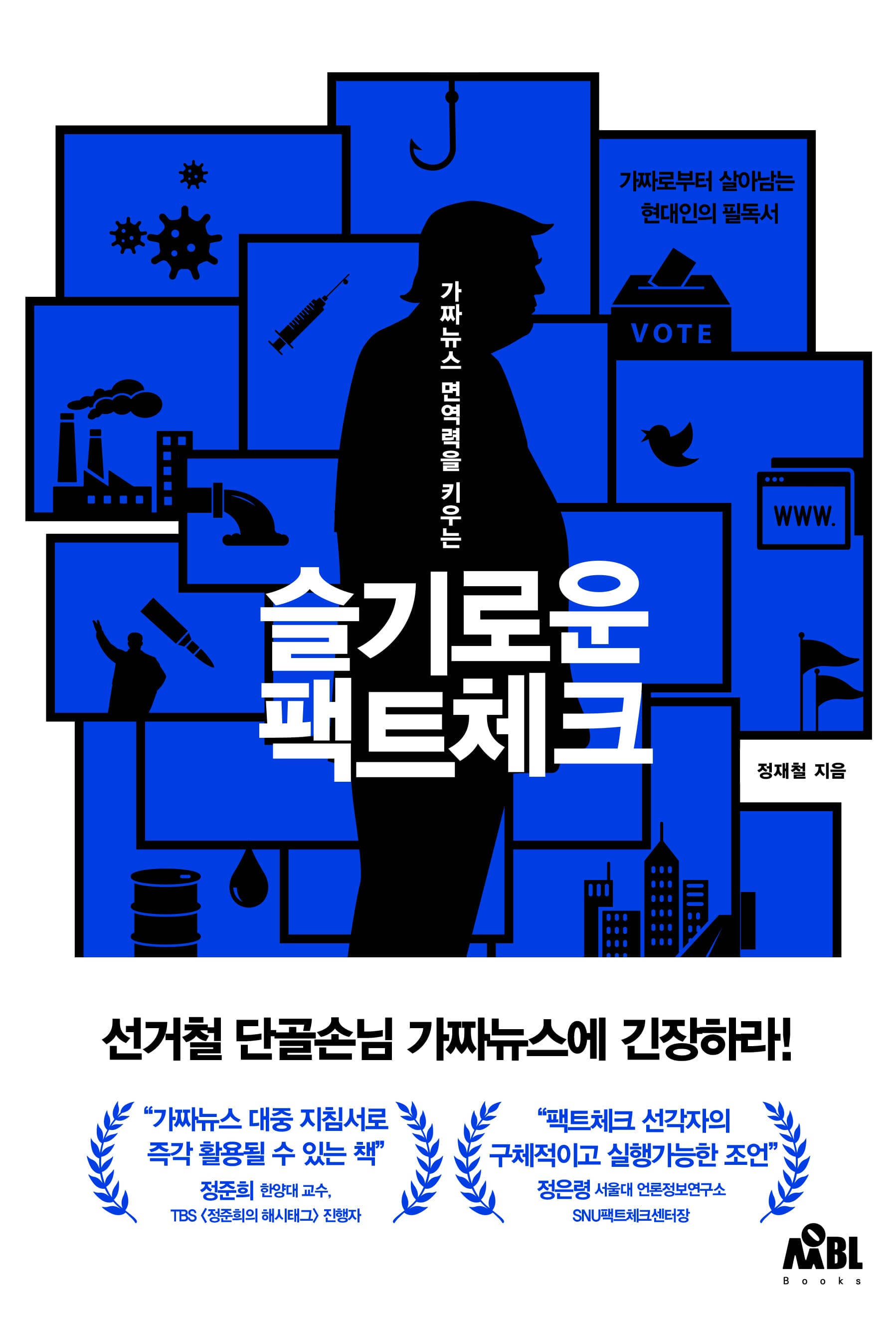
About This Book
도서 소개
Contaminated information. Fake news. Forged papers. What if you’ve been deceived? What if you unknowingly passed along fake news to others? This timely and practical guide provides the tools you need to respond to fake news!
★ Endorsed by Chong Eun-ryung, director of the SNU FactCheck Center
★ Recommended by Jung Joon-hee, professor at Hanyang University
In 2021, the International Fact-Checking Network (IFCN) was nominated for the Nobel Peace Prize—a recognition of the vital role fact-checking plays in reducing fear and misinformation among the people. During the COVID-19 pandemic, more than 800 people around the world died after a dangerous rumor: that drinking high-concentration alcohol could cure the virus. Fake news is dangerous because it infiltrates our daily lives through social media like Facebook and YouTube. This book offers practical, hands-on guidance drawn from the expertise of globally recognized fact-checking organizations , including the U.S.-based PolitiFact, Full Fact, and FactCheck.org. From professional tools like the Pinocchio Index and Truth-O-Meter to simple tips for verifying photos, audio, and videos, this book is designed to help you tell what’s real and what’s not.
“A timely and practical guide providing the tools you need to respond to fake news!”
(Jung Joon-hee, professor at Hanyang University; host of Jung Joon-hee’s Hashtag on TBS
“Clear, practical advice from a leading pioneer in fact-checking”
(Chong Eun-ryung, director of the SNU FactCheck Center, Institute of Communication Research, Seoul National University)
**Selected as Excellent Book of the Year by the Korea Press Foundation in 2021
**Selected as a Sejong Book in 2022
Table of Contents
목차
Table of Contents
Endorsements 04
Preface 06
1. Fake News: Unanswered Questions 09
2. Why Is Fake News Dangerous? 46
3. Why Do People Fall for Fake News? 68
4. How to Spot Fake News 88
5. Next-Level Skills for Reliable Fact-Checking 140
6. Enhancing Your Media Literacy and Digital Immune System 217
7. So, What Is Fact-Checking? 241
Afterword
Preview
미리보기
Endorsements
Journalist Jeong Jae-cheol is known as “an evangelist for fact-checking.” Long before the term became popular in journalism around the world, he recognized its value and played a key role in bringing it to Korea. He studied the process deeply and practiced it with care. You can see that dedication throughout this book. It serves not only as a guide for professional fact-checkers, but also as a helpful manual for anyone who wants to understand and fight fake news.
What makes this book stand out most is the wide range of real-life examples. Journalism is a field based on experience. Instead of just relying on theories, it deals with problems that happen in the real world. This book shows that fake news is a complicated problem—one that can’t be solved by learning just a few tips. We may laugh at silly headlines or low-quality stories and think journalism has failed. Some people ridicule reporters and boast that they would never fall for “such” fake news. They point their fingers at reporters for failing to do what even a non-expert could do and for contributing to the spread of fake news. But cleverly fabricated disinformation that seeps into our lives is not like a “b-rated” vampire that shrivels at a makeshift cross made with two fingers. Most of the people who think they’re immune to fake news end up becoming the “useful idiot” described in this book—spreading fake news without meaning to.
But Jeong Jae-cheol doesn’t stop at just showing us a graveyard full of cases. He also introduces key ideas and lessons learned by top fact-checking groups and researchers from around the world. He doesn’t just list them—he explains his findings from theory and practice clearly, using language anyone can understand. At first, some readers might feel overwhelmed by the number of cases and principles in the book. But the main lessons are actually simple:
• Be suspicious of any message that strongly matches your own feelings.
• Always check the source.
• If you’re not sure, wait before believing or sharing it.
Why? Because when we don’t know what’s really going on, we get anxious. Fake news feeds on that anxiety. It fills the gaps in what we know with lies and strong emotions. The price we pay for the comfort it brings can be that much fatal.
Fact-checking alone won’t save us, but realizing how important it is to check the facts is a good beginning. And deciding to walk the path of truth-seeking with others makes it even more meaningful.
An evangelist is someone who spreads the gospel. The word “gospel” actually means “good news.” But good news doesn’t mean “the truth itself”—it means a way to reach the truth. Some say people are saved by faith, but as theologian Jacques Ellul said, one must have questions with faith to be saved. To be more accurate, salvation begins when one decides to embark on the tough journey toward truth. Fact-checking alone will not save us, but realizing how important it is to check the facts is a good beginning. And deciding to walk the path of truth-seeking with others makes it even more meaningful.
This book is an invitation to that journey.
Jung Joon-hee, Adjunct Professor, Department of Media and Social Informatics, Hanyang University; host of Jung Joon-hee’s Hashtag on TBS
Jeong Jae-cheol was one of the first to advocate fact-checking when it was still relatively unknown in Korean journalism. He continues to study it, going beyond borders to follow the latest global trends. Thanks to his hard work, readers can find clear, practical advice on how to spot false information and conduct proper fact-checks on every page.
Chong Eun-ryung, Director, SNU FactCheck Center, Institute of Communication Research, Seoul National University (SNU)
Preface
The world today is suffering from an outbreak—not just of illness, but of misinformation. This outbreak is often called fake news, and it spreads like the flu. Just as the flu brings fever, chills, and body aches, fake news infects our minds, limiting our thinking capacity.
To prevent the flu, experts stress the importance of maintaining good hygiene, because it spreads through respiratory droplets from coughing or sneezing. Still, even the most careful person can catch it. That’s why we have vaccines—to help build immunity in advance and minimize the risk of contagion.
Fake news works in a similar way. It spreads rapidly through networks of people like social media. Once it takes hold, it can cause tremendous damage, which takes a long time and a lot of effort to undo. Like the flu, fake news can lead to serious consequences. In some cases, it even threatens lives.
Fighting fake news requires teamwork. Governments and lawmakers need to create effective policies and legislation. Journalists must develop new practices, like regular fact-checking. Online platforms such as Naver, Kakao, and social media companies should implement measures to stop the careless spread of false information. And each of us must strengthen our resistance to disinformation by sharpening our media literacy—the ability to question what we see and hear, and to recognize what’s real. This way, the various members of our society can better identify fake news and respond properly and avoid falling victim to fake news.
We may never fully eliminate fake news, which can be persistent, but we cannot ignore the harm it causes, for it is aggravating. Like COVID-19, fake news is a threat we must take seriously. That means practicing “information hygiene”==developing good habits to protect our minds from falsehoods.
Here’s something to consider. For diseases like the flu or covid, countries around the world have created and distributed vaccines. But what about fake news? Why hasn’t anyone developed a “vaccine” for misinformation?
That’s the question that inspired this book.
This book starts with the idea of “information hygiene” in our daily lives. It explores the idea of a vaccine to build immunity against fake news as well as a treatment to fight it. I hope more people can develop a strong digital immune system to spot fake news and push back against it.
![[2006 개정판] 흔들리지 않는 투자를 위한 경제지표 9](/_next/image?url=%2Fuploads%2F1780491977273-0nbbrg.jpg&w=3840&q=75)
![[2006 개정판] 무조건 합격! 소방안전관리자 2급 기출문제집 [종이책]](/_next/image?url=%2Fuploads%2F1777133475187-rvwgnp.jpg&w=3840&q=75)
![하루 30분 DeFi 코인 투자 [종이책-전자책]](/_next/image?url=%2Fuploads%2F1777132240120-8p096i.jpg&w=3840&q=75)